

Tapio RQP Live · plastic film and foil rolls
Roll hardness profiles for plastic film and foil rolls
For film, foil and laminate producers and converters. Push RQP Live across the roll and see the hardness variation built into it, the tension and gauge-related variation that the roll's surface does not show, checked against your own acceptance limits.
Why measure the hardness of film and foil rolls
Roll hardness reflects how tightly the material is wound, and with it the tension, thickness and density variation built into the roll. A uniform roll gives a flat profile. Soft zones and uneven winding tension turn into problems when the roll is unwound, printed, laminated or converted, and none of them shows on the roll's surface.
RQP Live records hardness continuously across the roll, so a soft zone in the middle of a roll is measured as well as one at its edge. In film, hardness has often followed the gauge profile closely.
"On certain materials, mainly paper and some harder grades of film, a roll hardness profile will 'see' the variation far better than your expensive scanner because it effectively measures (samples, averages) many hundreds of layers with every hit. Here again the connections between raw material thickness profile variation and wound roll profile and bagginess profile is profound and clear."
— Dr. David R. Roisum
Rolls and materials
Plastic film
- Flexible packaging: BOPP, BOPET, BOPA (nylon), PE, PP, PVC and PET
- Blown and cast film; technical and special films
- Thin, medical and industrial films, where tension and thickness variation matter
Metal foil
- Aluminum foil for food and pharmaceutical packaging
- Copper foil for electronics and printed circuit boards
- Laminates of foil with polymers or paper
Battery materials
- Separator films and coated separators
- Cathode and anode foils
Suitability, the risk of marking a sensitive surface and useful alert limits depend on the material and the roll, so check them on your own rolls, for example during a demo or a rental.
Case: a soft edge roll found before converting
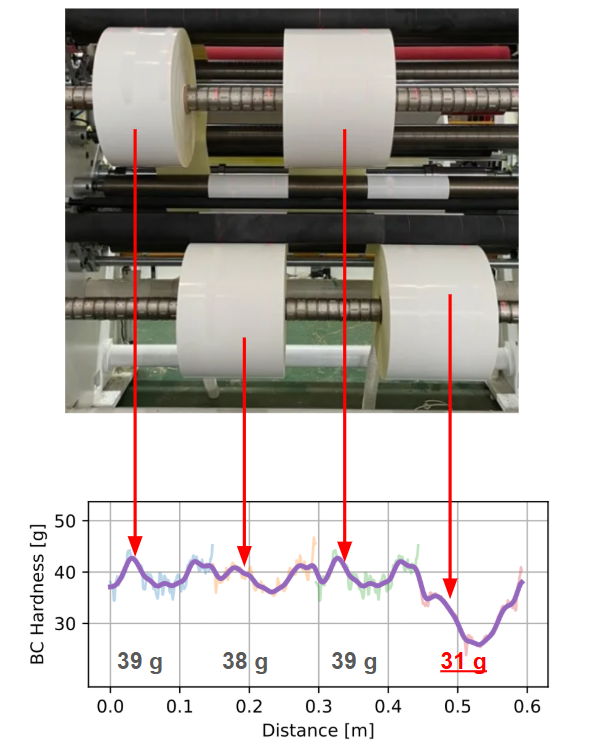
A plastic film producer had around 25 % of its rolls rejected by the customer in converting. The rolls looked normal at the production site, and visual inspection and process data did not explain the problem.
The producer measured every roll of a set at the rewinder with RQP Live and joined the profiles in Tapio RollView's continuous mode. One edge roll measured about 31 g against 38 to 39 g for the others, which corresponded well with the rolls that later caused converting problems. Only the middle of that roll was soft; its own edges were as hard as the other rolls.
What the operator sees at the roll
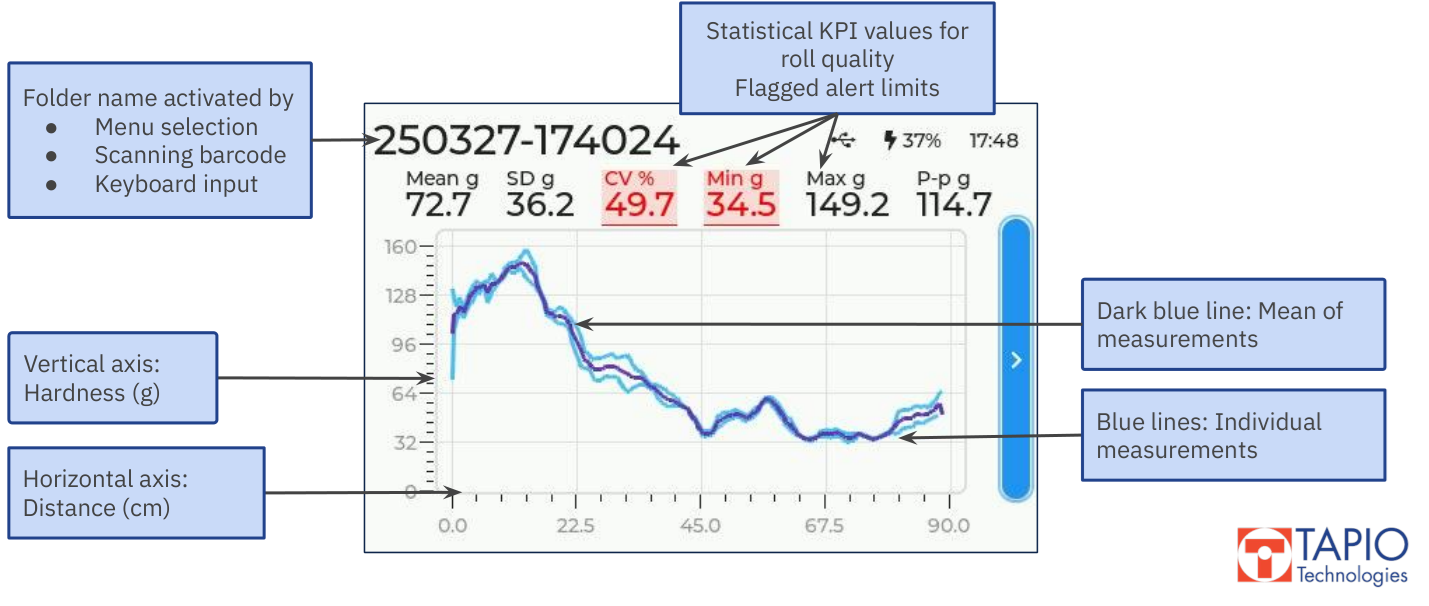
This plastic roll has a mean hardness of 72.7 g, but a CV of nearly 50 %, with values from 34.5 g to 149 g. The profile rises steadily from one end to the other; follow-up work pointed to thickness variation in the film.
CV% and the minimum are outside their alert limits, so both turn red on the display. You set the limits for your own product, on the device or in Tapio RollView. Limits are usually set from rolls known to have caused problems.
The profiles sync to the free Tapio RollView PC software, which shows every roll with its statistics against your alert limits and keeps a trend of roll statistics over days and weeks. The device, its specifications and RollView are described on the RQP Live product page.
Try RQP Live on your own rolls
There are several ways to try RQP Live on your own rolls before purchasing a device: rent a device and measure at your own pace, have us or one of our local partners demonstrate it at your plant, or see it in operation on a video call. The RQP Live demo page describes all three.
Ask about RQP Live for your rolls
Book an RQP Live demo, ask about renting a device, ask for a quotation, or ask us to check whether RQP Live suits your rolls.
Tell us about your rolls and what you want to measure. You can also email info@tapiotechnologies.com.
Prefer to talk to a person? Contact us directly:

Thank you. Your RQP Live enquiry has been received. We normally respond within one working day.