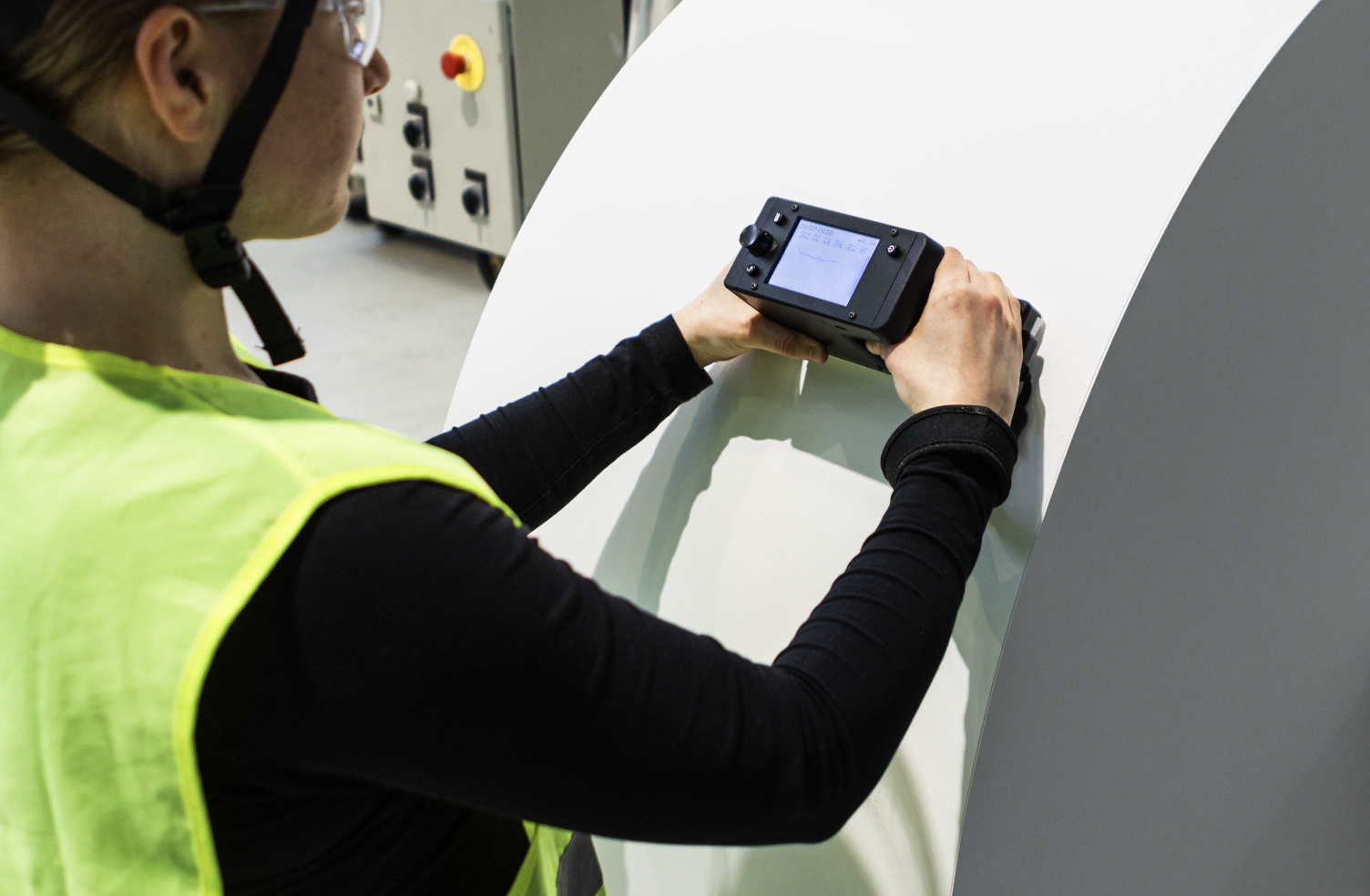
Roll hardness measurement is one of the few practical, non-destructive ways to understand the internal structure of wound rolls. It is used not only for paper and board, but also for plastic films, flexible packaging films, technical films, laminates, foils and other roll-to-roll materials.
In all these applications, the question is similar: is the roll wound evenly enough to run reliably in the next process?
This article compares four common approaches:
Each method has its place. For occasional checks, traditional methods may be enough. For repeatable roll quality control, roll acceptance decisions and process improvement, a digital roll hardness profiler provides much more useful information.
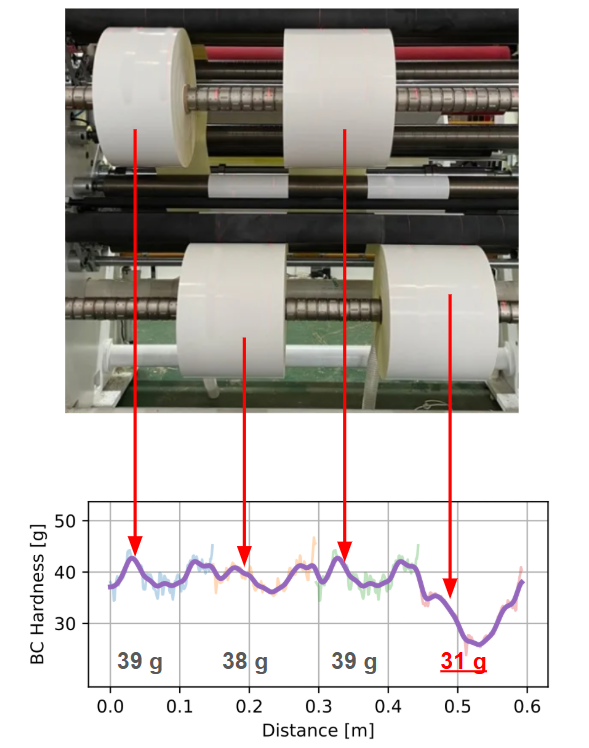
A roll can look acceptable from the outside but still contain internal hardness variations that cause problems later in production.
In paper and board, uneven roll hardness can contribute to runnability problems, web breaks, slitting issues, converting defects and customer complaints. In plastic films, flexible packaging, technical films and foils, hardness variation can indicate tension variation, thickness or caliper variation, loose edges, blocking risk, wrinkles, deformation or other roll structure problems.
Roll hardness measurement helps detect these issues before the roll enters the next production or converting step.
However, the value of the measurement depends strongly on how the hardness data is collected. Single-point measurements can give a rough indication of hardness level, but they cannot always show the full structure of the roll. That is why it is often important to obtain an actual high-resolution hardness profile from produced rolls.
The oldest roll hardness test is still familiar in many mills: an experienced operator knocks the roll surface with a stick, rod or similar tool and listens to the sound. This method has practical value. It is fast, simple and based on real operator experience. In some cases, a skilled operator can recognize clearly soft or hard areas by sound and feel. The limitation is that the result is subjective. It is difficult to document, difficult to compare between operators and almost impossible to use as part of a modern quality database.
Schmidt Hammers and other single-point hardness testers made roll hardness measurement more objective by replacing sound and feel with a numerical rebound value produced by the instrument. Digital profilers take the next step by measuring the full hardness profile (including hardness values and distance) across the roll width, storing the data and making the result easier to analyze, compare and integrate.
The goal is no longer only to check whether a roll “feels right”, but to create repeatable, documented hardness profiles where both the profile shape and statistics can be used to support quality decisions and process improvement.
A roll hardness profiler is a device that measures hardness values across the roll width. Typically, the measurement is based on an impact or rebound principle. The instrument records the hardness signal together with the measurement position, producing a profile of the roll structure.
A roll hardness profile can help detect:
This makes profiling useful for roll quality control, troubleshooting, roll acceptance and process optimization.
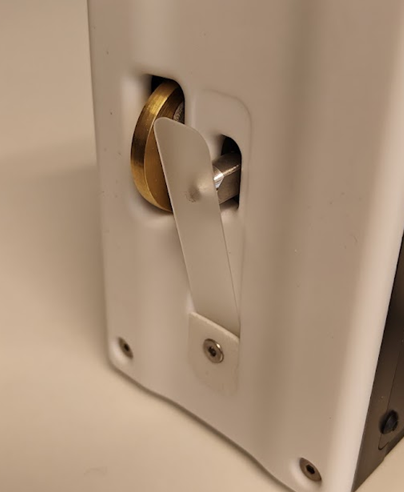
Manual tools such as stick testing and rebound hammers are useful for quick checks. They are simple, familiar and, in many plants, part of everyday quality control.
The limitation is that the result depends heavily on how the measurement is performed. If measurements are taken only at selected positions, the quality of the profile depends on measurement spacing, operator consistency, impact technique, position tracking and the available measurement time.
A narrow defect can also be missed. For example, if an operator measures every 100 mm and a soft streak is only 40 mm wide, the defect may not be measured at all.
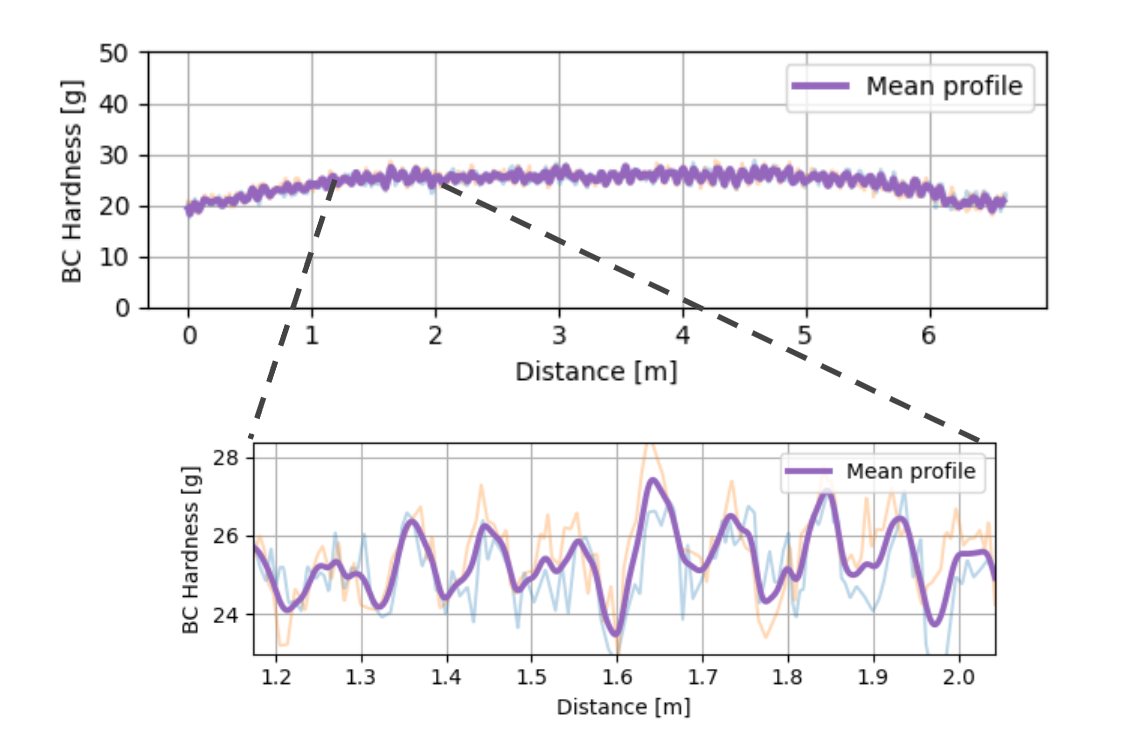
Digital profilers such as Tapio RQP Live and ACA RoQ record frequently measured hardness and position data together. Instead of relying only on selected points, they collect a denser set of data in a single pass. Several passes can also be measured from the same roll and averaged into a mean profile, which gives a more stable basis for statistical analysis.
A full hardness profile allows the roll to be evaluated with useful statistical indicators (Roll Hardness Profiles – What Can the Statistics Tell Us?), not only the average hardness value:
A roll may have an acceptable mean hardness but still show high variation, local defects or a clear slope across the width. In practice, this can reveal uneven winding structure, tension variation or local defects that may not be visible from spot measurements alone.
Stick testing is the simplest method. The operator knocks the roll surface and evaluates hardness by sound and feel. It is useful when a fast informal check is needed. It requires no electronics, no setup and no data transfer. However, the result depends completely on operator experience. It does not produce numerical data, cannot be easily documented and is not suitable for statistical quality control.
Best suited for:
Not suited for:
The Schmidt Hammer method uses rebound measurement to give a numerical hardness value. The Paper Schmidt PS8000 is a roll hardness tester based on rebound hammer technology and is used for paper and foil roll testing.
Compared with stick testing, this is a more objective method because the result is numerical. It can also support data handling through PC, mobile app or printer workflows.
The practical limitation is measurement density. If the roll is measured only at individual points, the profile depends on how many measurements are taken and how evenly they are spaced. Creating a detailed profile manually takes time and requires a consistent routine.
Best suited for:
Less ideal for:
ACA RoQ is a handheld digital roll hardness analyzer for on-the-spot quality control. It is described for measuring individual rolls, including parent reels before the winder and customer rolls after slitting. ACA also presents applications in paper and board, converters, flexible packaging and plastic films.
Compared with stick testing or simple manual spot checks, ACA RoQ provides a digital profile and a clearer view of the roll hardness profile shape.
ACA RoQ is well suited when the user wants a portable digital profile for general roll quality monitoring and documentation.
Best suited for:
Tapio RQP Live is a real-time roll hardness profiler designed for high-resolution measurement, live feedback and digital quality control.
It is suitable for paper, board and plastic rolls, but the application range is broader than traditional paper roll testing. Typical applications include plastic films, flexible packaging, BOPP, BOPET, BOPA, PE, PP, PVC, PET, technical films, special films, metal foils, laminates and battery films or foils.
The device measures the deceleration of an impact hammer while simultaneously tracking the measurement position. The result is a detailed hardness profile across the roll width. The profile is shown to the operator already during and right after the measurement, improving data quality. This means the operator can see the roll structure immediately, not only after transferring the data to a computer.
Tapio RQP Live also supports configurable alert limits. These can give immediate feedback during measurement if the roll is outside the defined quality limits.
The measurement data can be analyzed further in Tapio RollView. In both Tapio RQP Live and Tapio RollView, several profiles from the same roll can be stored in one folder, averaged into a mean profile and used for mean profile statistics such as mean hardness, standard deviation and CV%. Tapio RollView also supports profile comparison and postprocessing for data export or integration.
Key features include:
Tapio RQP Live is especially useful when rolls are measured against defined specifications, when repeatability between operators is important, or when hardness data is used as part of Statistical Process Control.
Best suited for:
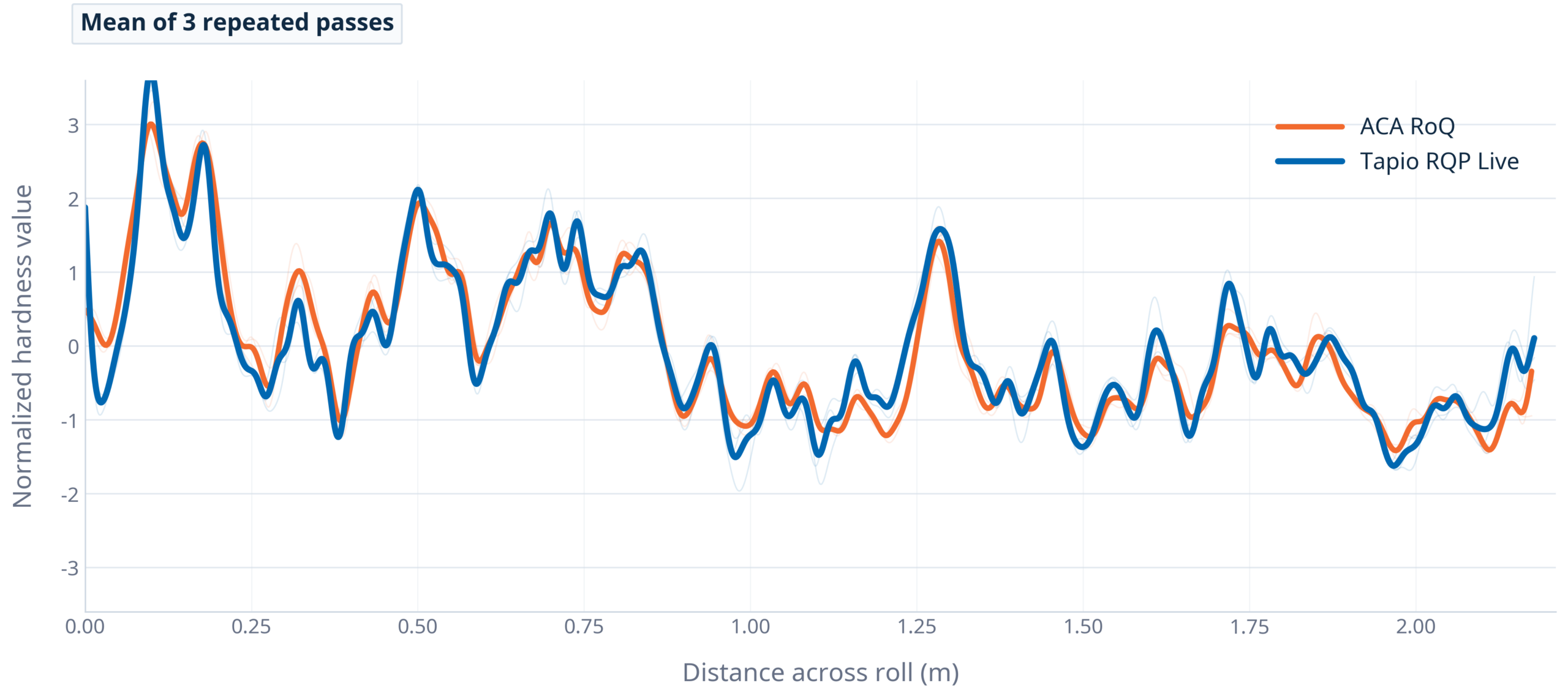
When measuring the same roll, Tapio RQP Live and ACA RoQ can show the same general roll profile shape. This means both instruments can identify the main winding structure, ridges, soft areas and cross-direction hardness trends. Both systems can support repeated measurements and averaged profile analysis. The difference is mainly in detail level, live usability, data handling and the flexibility of the analysis workflow.
ACA RoQ provides a digital profile and a clear overview of the general hardness shape. For routine quality monitoring, this may be enough. Tapio RQP Live is especially suitable for situations where the operator needs to see the full profile in real time, react to limit violations immediately and use the measurement data for more detailed analysis. Tapio RollView also allows the profile to be studied using adjustable filtering and analysis tools. This makes it possible to look at both the general profile shape and smaller structural details.
One of the main practical differences between manual checks and profiling devices is repeatability. With manual or sparse measurements, two operators may produce different results from the same roll. This does not necessarily mean that the roll changed. The difference can come from measurement spacing, position tracking, impact technique or the measurement routine. For rough checks, this may be acceptable. For roll acceptance decisions, repeatability becomes much more important.
Tapio RQP Live reduces operator dependence by measuring hardness and position together. The result is a repeatable profile that can be compared between operators, shifts and production days.
Modern mills and converting plants increasingly need quality data to move into reporting systems, quality databases or process control workflows. Manual measurements are difficult to integrate because the data often needs to be recorded separately. This creates extra work and increases the risk of errors.
Digital profilers make the process easier by storing the profile electronically. Tapio RQP Live is specifically designed for this type of workflow. Measurement data can be transferred to Tapio RollView, analyzed on a computer, exported as machine-readable files and processed further using RollView’s postprocessor functionality.
This is useful when the customer wants to compare rolls statistically, connect hardness profiles to a wider quality control system or automate reporting.
Tapio RQP Live stands out by supporting configurable alert limits that trigger pass/fail feedback during the measurement itself. An operator knows before they have even finished the pass whether the roll meets the customer’s specifications.
For mills producing rolls to tight tolerances for film or specialty paper, this represents a massive reduction in the time between measurement and the final “ship or reject” decision.
| Feature | Tapio RQP Live | ACA RoQ | Schmidt Hammers | Stick testing |
|---|---|---|---|---|
| Continuous high-resolution profile | ✓ | ✓ | ✕ | ✕ |
| Real-time profile display | ✓ | ✕ | ✕ | ✕ |
| Operator-independent profile quality | ✓ | ✓ | ✕ | ✕ |
| QR configurable alert limits | ✓ | ✕ | ✕ | ✕ |
| Advanced PC analysis software | ✓ | ✕ | ✕ | ✕ |
| Digital data export | ✓ | ✓ | ✓ | ✕ |
| Cost-effective option | ✓ | ✕ | ✓ | ✓ |
Stick testing: informal operator check
Stick testing is useful when an experienced operator needs a very fast impression of roll condition. It is not a replacement for measurement data, but it can still have value as a practical first check. Use it when the check is informal, documentation is not required and the defect is expected to be obvious.
Schmidt Hammer / Paper Schmidt: numerical rebound measurement
A Schmidt Hammer or Paper Schmidt is useful when the goal is to measure roll hardness numerically at selected points or as a manually created series. It is a practical method for routine hardness checks, especially when the user wants a familiar rebound-based instrument. Use it when approximate hardness level or basic profile information is enough. It is less suitable when the main requirement is dense profile data, narrow defect detection, real-time profile decisions or automatic quality system integration.
ACA RoQ: Digital Profiling for General Trends
ACA RoQ is suitable when the customer wants a portable digital roll hardness profile and a clearer view of general profile shape than traditional manual checks can provide. Use it when the main goal is general roll quality monitoring, parent reel or customer roll checking, and digital documentation. It is a useful step from manual measurement toward digital roll hardness control.
Tapio RQP Live: real-time profiling for paper, board, films and foils
Tapio RQP Live is best suited for applications where the full hardness profile must be visible, repeatable and useful immediately during measurement.
Use it when:
For mills, film producers and converters that need reliable, repeatable and detailed roll hardness data with a process that is easy to implement in the shop floor, Tapio RQP Live provides the most complete measurement workflow.
Stick testing, Schmidt Hammers, ACA RoQ and Tapio RQP Live all have their place in roll hardness measurement.
Stick testing is still useful as a quick operator check. It is fast and simple, but the result is based on experience, sound and feel. It can help an experienced operator notice obvious soft or hard areas, but it does not produce data that can be stored, compared or used for reporting.
A Schmidt Hammer or Paper Schmidt gives a numerical rebound value. This makes the measurement more objective than stick testing, but it is still mainly a point measurement. The result depends on where the operator measures, how many points are taken and how carefully the same positions are repeated.
ACA RoQ is a known digital roll hardness profiler and can be suitable when the main need is to record the general hardness profile of a roll.
Tapio RQP Live is designed for modern roll quality control. The operator sees the profile during the measurement, can use limit feedback directly on the device, and can continue the analysis in Tapio RollView without a complicated workflow. The same data can also be exported for reporting or integration with mill quality systems.
The important question is not only which instrument gives a hardness value. It is how easily the measurement can be made, understood, repeated and used after the roll has been measured
Stick testing, Schmidt Hammer measurements, ACA RoQ and Tapio RQP Live all have a place in roll hardness control. The right choice depends on what the measurement is expected to do.
If the goal is a quick informal check, stick testing may be enough. If the goal is a numerical spot or series measurement, a Schmidt Hammer or Paper Schmidt is a practical tool. If the goal is to document the roll hardness profile digitally, ACA RoQ can be a useful profiling solution. If the goal is high-resolution profiling, repeatable roll acceptance with analysis tools, real-time feedback and integration into modern quality control workflows, Tapio RQP Live is the strongest choice.
This is especially important when measuring high-value rolls such as plastic films, flexible packaging materials, technical films, laminates, metal foils and battery films, where small thickness, tension or winding variations can create expensive downstream problems.
Roll hardness control is moving from experience-based judgement toward documented, repeatable and data-driven profiling. For producers and converters that want to reduce roll-related problems and make faster quality decisions, this shift is increasingly important.
Want to see how high-resolution roll hardness profiling works in your facility?
We typically respond within one day.
References
Product information in this article is based on publicly available manufacturer materials for Aca RoQ and Paper Schmidt PS8000. Practical comments are based on Tapio’s own application experience and customer feedback from roll hardness measurement applications.