
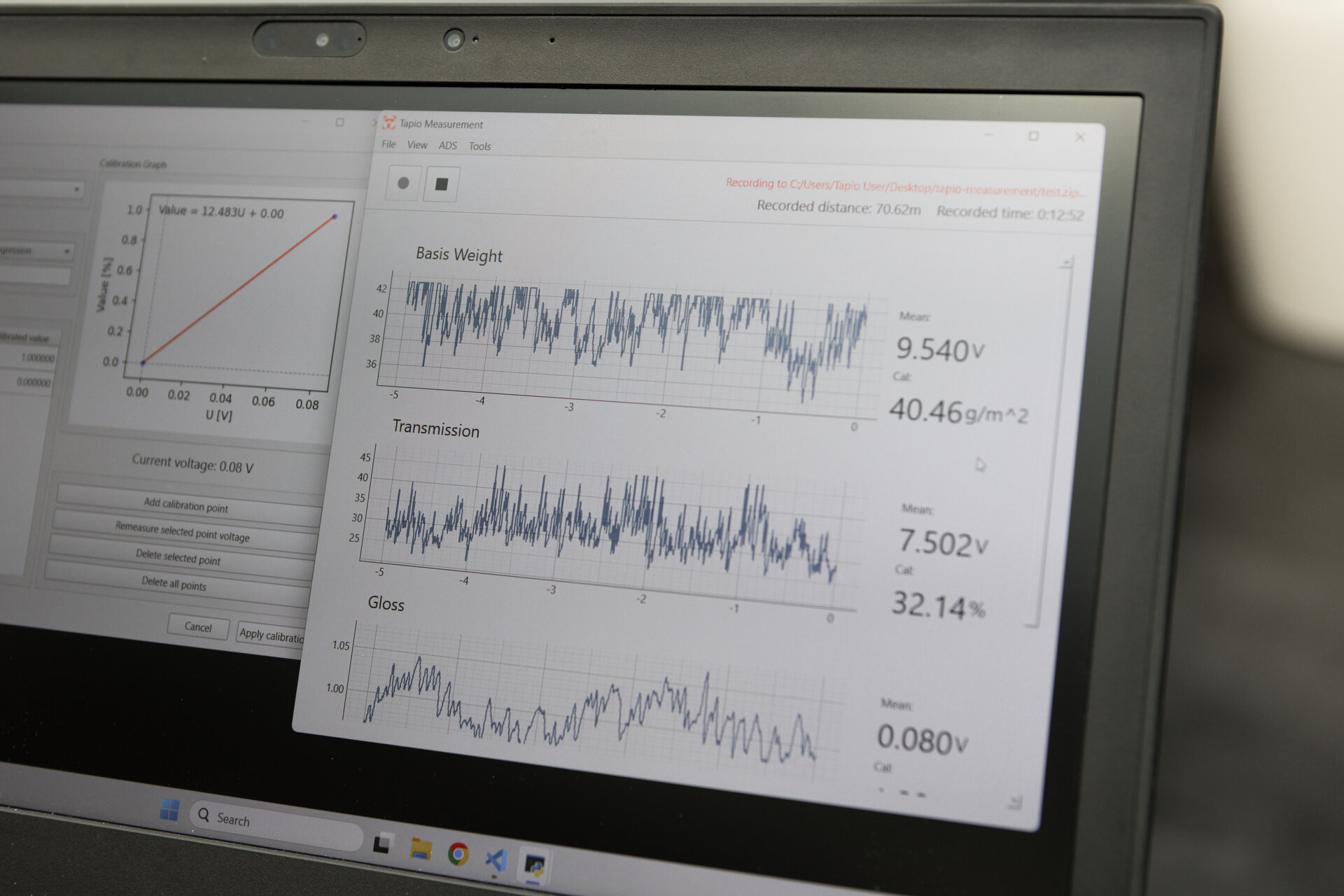
Have you ever chased a persistent basis weight, moisture, or caliper variation, only to find that the online scanner does not clearly show the root cause? This is a common situation in paper and board mills. The scanner shows one profile, the roll behavior suggests another, and the process issue remains difficult to explain.
Online QCS scanners are essential tools for process control. However, they also have physical limitations. They cannot see the sheet in exactly the same way the paper machine produces it, because the sheet moves forward at high speed while the scanner head moves slowly across the web. The result is not a pure cross-direction measurement, but a diagonal measurement path through the sheet. This becomes especially important when variations have a short wavelength or occur at a small scale.
Pressure pulsations in the approach flow system are common. They can originate from pressure screens, pumps, pipe vibrations, hydraulic resonances, or other rotating equipment. Many of these pulsations are in the range of 10–50 Hz. At normal paper machine speeds, this can create relatively short wavelength machine direction variation in the sheet. Typically as the pulse spreads in the headbox, a diagonal combined MD/CD variation is also produced, depending on the production speed as well as the flow rate of the headbox.
These kinds of variations are especially difficult to measure with online scanners. Because of the scanner path, sampling rate, spot size, and internal averaging, a fast MD/CD variation can be heavily smoothed, missed completely, or displayed in a misleading way.
In practice, a true MD pulsation may appear on the scanner display as a CD variation. The mill team may then start correcting the slice, dilution profile, actuator settings, or other CD controls, even though the original cause is located in the approach flow system or wet end dynamics. This is one way the scanner can unintentionally guide troubleshooting in the wrong direction.
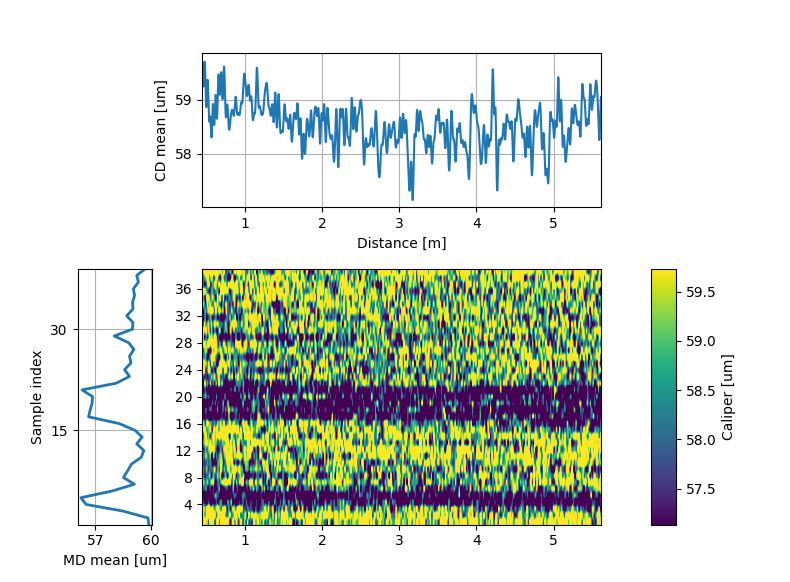
Some pulsations are simple and stable. A pressure screen rotor, pump, or mechanical vibration may create a clear periodic disturbance. However, the situation becomes more complicated when several frequencies interact. For example, two screen rotors running at almost the same speed can create a slow beating variation. The original frequencies may be relatively fast, but their interaction can produce a slower repeating pattern that appears in the finished paper.
With many frequencies interacting in the end product, it is possible to measure harmonics, sidebands, sum/difference frequencies, and amplitude modulation, and the observed paper variation may not correspond directly to only one rotor speed or one pump speed. This is one reason why these problems are often difficult to solve by looking only at standard process trends.
There are several practical reasons why online scanners may fail to reveal these problems clearly.
Firstly, the measurement path is diagonal. The scanner does not take a complete CD profile from the same instant in time. It moves across the web while the paper is moving forward, which mixes MD and CD information. Second, the measurement spot in online scanners can be relatively large. Short wavelength variations are averaged over the sensor area. The faster or shorter the variation, the more likely it is to be blurred. Thirdly, the scanner signal is typically heavily filtered before it is shown to the operator. This is necessary for stable process control and also helps to reduce noise from vibrations and prevent aliasing. However, the filtering can reduce the visibility of fast pulsations or other high-frequency variations. In practice, these variations may appear weaker, broader, or may not be visible at all in the scanner display.
In the worst case, the scanner display can make an MD problem look like a CD problem or vice versa. This does not mean that the scanner is unreliable. It just means that scanners are designed primarily for continuous process control, not for high-resolution root cause diagnostics.
When the online scanner does not give the full picture, offline diagnostics become important. A useful first step is to compare the scanner profile with real roll-based measurements. Roll hardness is often a practical way to reveal variation that the scanner has averaged away or misinterpreted.
The Tapio RQP Live Roll Hardness Tester can be used to verify roll structure and profile variation directly from the roll. If the roll hardness profile does not match the scanner profile, this is an important signal. It suggests that the roll contains variation that is not being represented correctly by the online measurement.
Further high-resolution offline measurements can then be used to separate MD and CD variation more reliably. With Tapio Analysis, true CD profiles of several different quality parameters can be studied. In addition to millimeter-level profiles of Basis weight, Caliper, Transmission, Ash, Gloss and Porosity, correlation analysis and spectral tools can be used to investigate the data in more detail. This helps determine whether the variation is linked to the wet end, forming section, coating, drying, calendering, winding, or another source.
The high-resolution CD profile data can also be used to calculate the shrinkage profile. This is important because the profile measured at the reel is not necessarily the same as the profile that existed at the wet end. The paper web shrinks during drying and finishing. Tapio also offers a specialized calculation method for this type of analysis without requiring physical marking at the wet end.
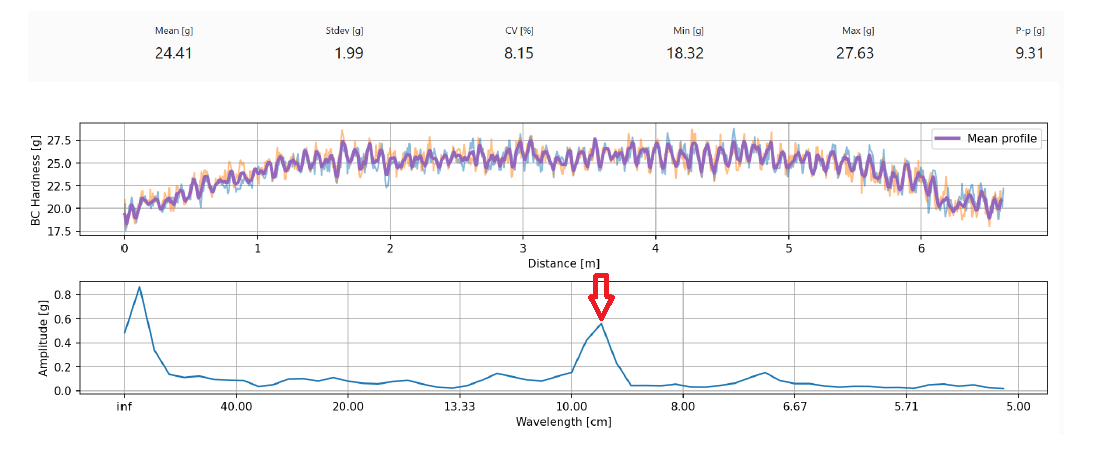
Spectral analysis is a useful method for identifying regular variations in both MD and CD profiles. When a profile contains a repeating wave, the eye may only see a rough pattern. Spectral analysis can reveal the exact wavelength and strength of the variation. This makes it easier to connect the paper defect to a possible mechanical or process source.
In the machine direction, roll, pump and felt frequencies correspond to peaks in the spectrum. It is also possible to do spectral analysis in the cross direction. Regular CD variations may originate from the headbox, showers, roll covers, coating systems, or forming section components. One common example is variation related to gap former wires. Regular outer wire tension variation can create repeating profile patterns, sometimes with wavelengths around 100 mm. These structures may not be obvious from standard scanner data, but they can become clear when the sheet is measured with sufficient resolution and analyzed correctly.
Do not rely only on the online scanner when solving persistent basis weight, moisture, or caliper problems. The scanner is an excellent control instrument, but it is not always a complete diagnostic instrument. If the problem is caused by fast pulsations, short wavelength variation, wire-related patterns, or other regular structures, the scanner may not be able to show the real cause.
Roll hardness measurements often correlate strongly with caliper, moisture, and basis weight profiles. When these measurements show systematic repeating waves, the next step is to measure the sheet with enough resolution to find the true wavelength and direction of the variation. Once the wavelength and direction are known, the root cause becomes much easier to locate.
In challenging diagnostic cases, it is often useful to combine several measurements:
If the scanner profile and the roll behavior do not agree, the roll should not be ignored. The roll may contain real variation that the scanner is not able to represent correctly.
Tapio Analysis measurements are available as a service from customer-provided CD strips of MD rolls.
We typically respond within one day.