Continous Profile Porosity Sensors

Porosity: an important quality parameter

Porosity and air/gas permeability are important quality parameters for many paper, board and nonwoven products. Laboratory testers can be used to obtain porosity measurements from individual samples.


In many cases it would be useful to know if the porosity varies as trends in the machine direction (MD) or in different regionsin the cross direction (CD).  In all papermaking processes, different regions of the web , especially the edges, will always have different physical properties.


Unlike a Tapio Analyzer, online traversing QCS Scanners are limited in sample spacing due to the high production speeds and they cannot true CD profiles because the web is constantly moving. 


How does a porosity sensor work?

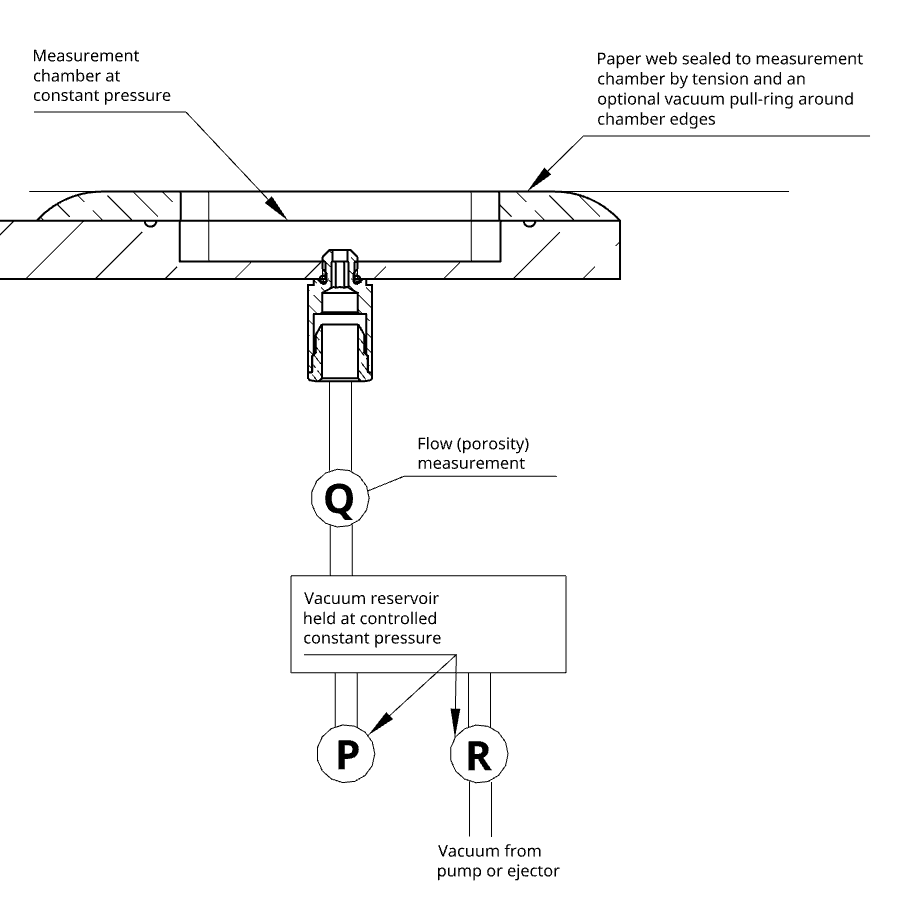
The figure to the right presents the basic structure of the sensor. A measurement chamber at the paper web is held at constant pressure (vacuum level depending on a standard) and the air flow rate is measured. In a Tapio Analyzer, the web can be tightened  on the sensor surface by geometric placement.


Depending on the application, implementations may include: 

• Placing the pressure transducer directly in the measurement chamber.  

• Reducing the leak rate and improving the seal by ysing a suction ring or by polishing the surface around the measurement chamber 

• Measuring not just the air flow but also pressure and compensating regulator drift with the values


Schematic diagram of a paper porosity measurement system with a sealed chamber, flow measurement, and vacuum control.
Measurement principle of a porosity sensor. The measurement chamber covered by the measured paper is held at constant pressure by an accurate vacuum pressure regulator and the resulting flow through the paper is measured to determine the porosity.
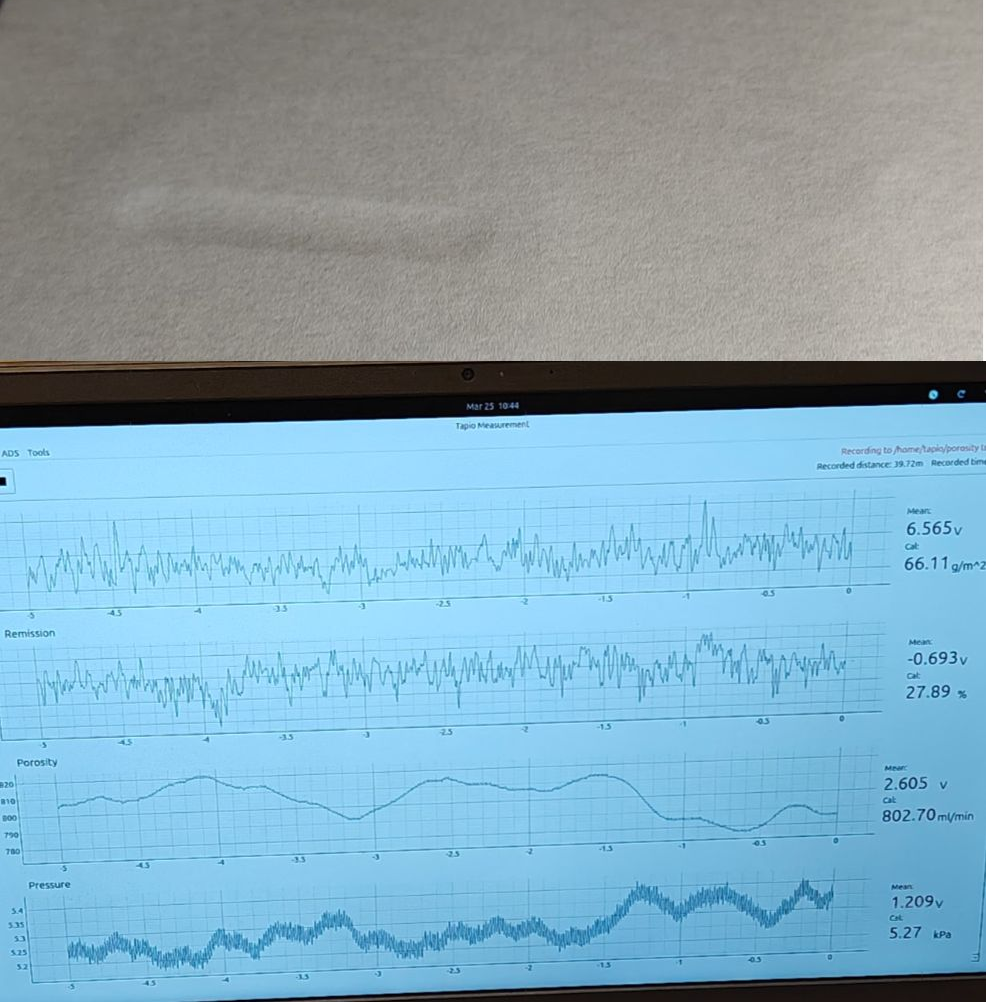
Paper sheet on a measurement device with a screen displaying porosity, pressure and signal graphs.
The Tapio Measurement software allows for convenient measurement and calibration of all involved signals, using pre-determined values, functions or calibration samples to map sensor voltages into the physical quantities being measured.

Benefits of Tapio porosity profiles

Tapio Technologies has been offering porosity profile sensors for almost two decades. The sensors are suitable for use in Tapio Analyzers or as online sensors in suitable production lines.  


Porosity measurement is available for all new and current Tapio users. With Tapio Analysis you can detect variations invisible to QCS and link the measured variations to machine elements. Tapio Analyzers measure porosity AND correlate it with other physical properties (e.g. caliper, basis weight, ash content) at the exact same point in paper.


For customers without access to a Tapio Analyzer, we provide measurement services. Simply:

1. Send us your sample (MD roll or CD strips cut from parent reel)

2. We prepare and measure the sample with a Tapio Analyzer, 

3. You get the measurement report, original data and root cause analysis

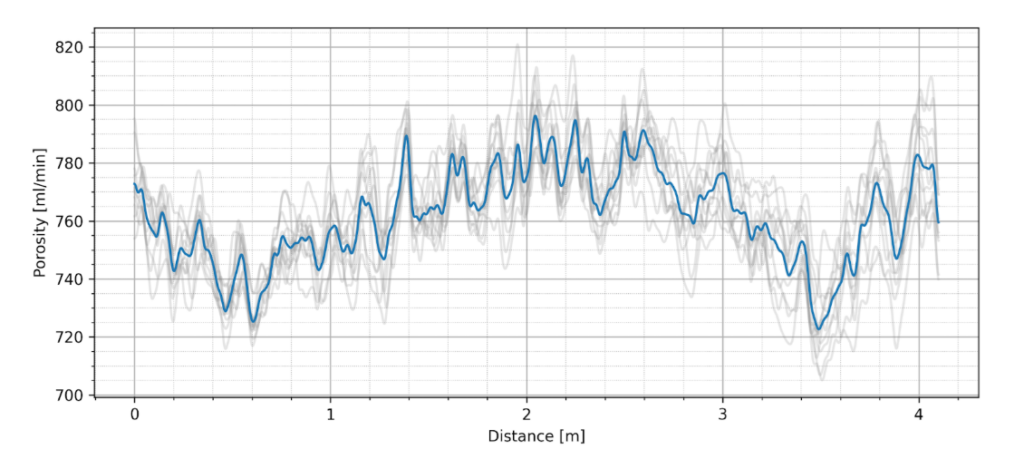
High-resolution cross-direction porosity profile with multiple individual strip measurements and a mean profile.
A high-resolution CD porosity profile measured from 13 true CD strips of paper cut from a parent reel. The gray lines represent the individual CD strips and the blue line is the mean profile. The fine variations repeating in each CD profile cannot be reliably measured with traversing scanner systems.