Reducing plastic film roll rejections with roll hardness profiling

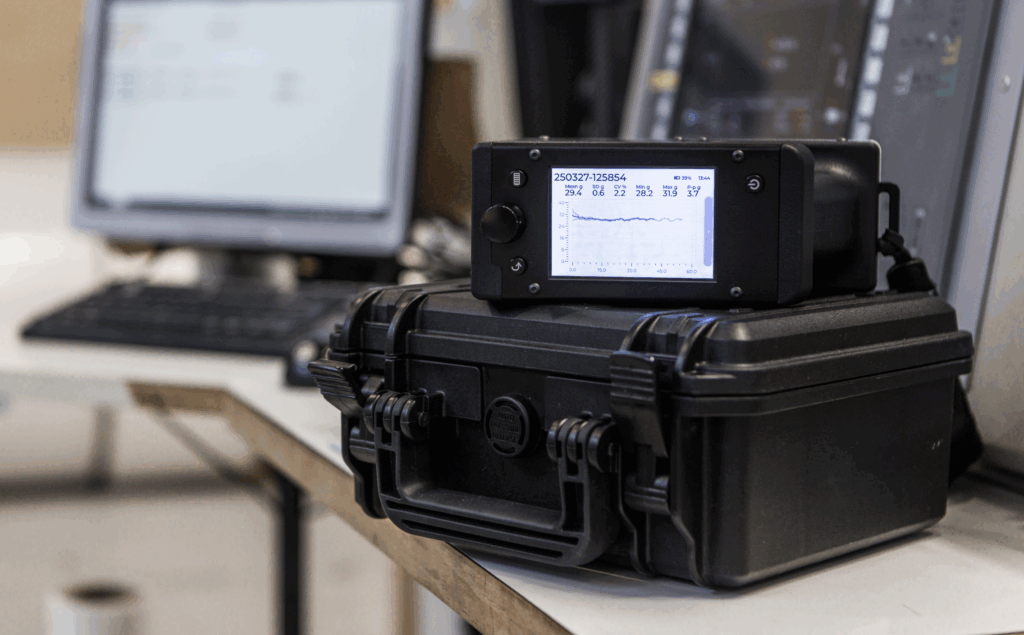
Tapio RQP Live device with a graphical display showing a roll hardness profile, placed on a black protective case in an industrial environment.
The Tapio RQP Live produces an instant high-resolution hardness profile. Alert limits for out-of-spec rolls allow for immediate flagging of problematic rolls.

A plastic film producer was experiencing quality issues: around 25% of produced rolls were rejected by the customer in converting. Visual inspection and process data did not explain the problem, as the rolls looked normal at the production site.

The producer started measuring roll hardness with the Tapio RQP Live directly at the rewinder. Each roll was measured separately, and the results were then combined using Tapio RollView continuous mode, which allows single roll measurements to be viewed as one continuous hardness profile.

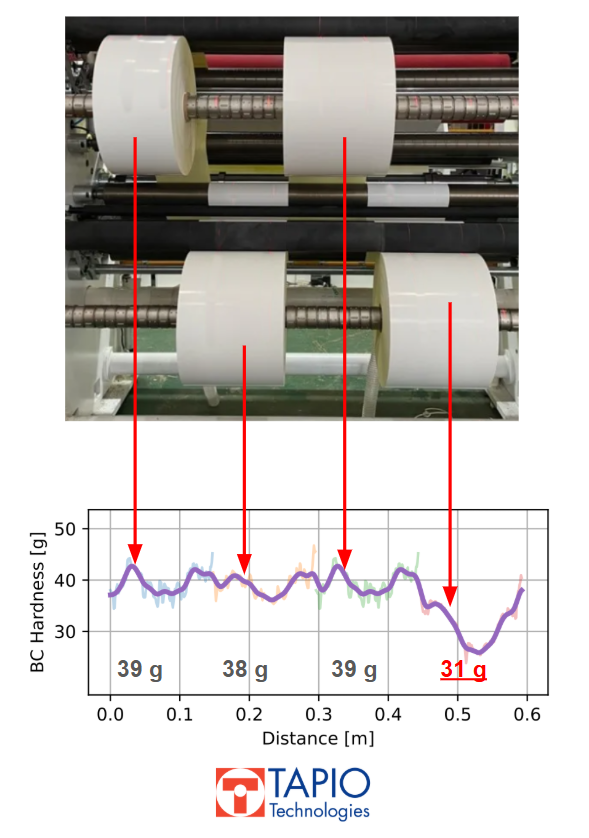
The hardness profiles showed that the edge rolls were softer than the others. One roll had a hardness of about 31 g, while the remaining rolls were in the range of 38–39 g. This corresponded well with the rolls that later caused converting issues. Such differences may be caused by misalignment, tension differences or variations in the cross-direction thickness profile.

Winder rolls on a paper machine with measured hardness profiles showing a local softness defect at one roll position.
Although all rolls appear visually similar at the rewinder, the hardness profiles reveal a difference between roll positions. One roll has significantly lower hardness (31 g) than the others, explaining downstream converting problems that were not detectable by visual inspection or process data alone. The Tapio RollView software makes comparisons like this easy, by also allowing the use of the continuous mode, where multiple individual roll profiles can be used to artificially form a hardness profile with the width of the original parent roll.


Without hardness measurements, this difference in the rolls would not have been visible. Furthermore, only the middle part of the edge roll was softer while the edges of this roll were of similar hardness to the other rolls. This is a situation that may not have been revealed by single-point hardness testers. Tapio RQP Live measures hardness 30 times per second simultaneously with distance, producing a high-resolution hardness profile.

Tapio RQP Live provides insight into winding quality across the full web width for paper, board, and plastic films as well as other rolled products. Unlike many other quality control systems, the hardness profile data is obtained easily and non-destructively from real rolls after production, storage and transport. RQP Live helps producers move beyond single-point measurements and subjective assessment, to ensure consistent quality and prevent costly roll defects.